


Mastering Interactive App Development: 2026 Guide
Is your brand merely a spectator in its own industry, or are you the architect of the experience? Whilst static presentations once sufficed for the boardroom, they now often fail to capture the imagination of high-value leads who demand depth, participation, and immediate relevance. You likely recognise the frustration of watching a complex, premium product lose its impact when trapped behind a flat, unresponsive screen. This is where interactive application development moves from a technical luxury to a strategic necessity for the modern UK enterprise. It's the prestige bridge between abstract brand values and tangible audience participation, ensuring your digital presence reflects the uncompromising quality of your brand.
Discover how bespoke interactive software and AI-driven applications transform passive observation into powerful, high-conversion brand participation. This 2026 guide provides a comprehensive roadmap for mastering the intersection of high-end visual content and intelligent automation. We'll explore: IMMERSIVE ENVIRONMENTS, INTUIFACE PLATINUM STRATEGIES, and AI INTEGRATION. By the end of this article, you'll understand how to replace outdated methods with a seamless, high-tech reality that secures engagement and drives measurable results.
Table of Contents
Defining Interactive Application Development for the Modern Enterprise
The Architecture of Engagement: Core Components of Bespoke Interactive Software
Strategic Platform Selection: Bespoke Development vs Specialised Frameworks
Maximising Impact: A Framework for Deploying Interactive Experiences
Elevating the Experience: The Quintessence Approach to Digital Enablement
Defining Interactive Application Development for the Modern Enterprise
The era of the passive audience is over. Whilst traditional marketing once relied on broadcasting information to a captive but static observer, modern engagement demands a sophisticated dialogue; it is a fluid exchange where the user dictates the pace and depth of their journey. For the high-end enterprise, the transition from passive media to active participatory environments isn't merely a trend but a fundamental shift in how value is communicated. Interactive application development is the strategic fusion of sensory content and responsive software logic.
In high-stakes sectors like luxury property, automotive, and industrial manufacturing, interactive software has become a non-negotiable asset. It serves as the vital bridge between an abstract brand story and tangible customer behaviour. When a client interacts with a digital environment, they aren't just looking at a product; they're exploring its DNA. This level of digital enablement ensures that the gap between a complex value proposition and a lead's understanding is closed through direct, personal experience.
Beyond the Screen: The Scope of Modern Interactivity
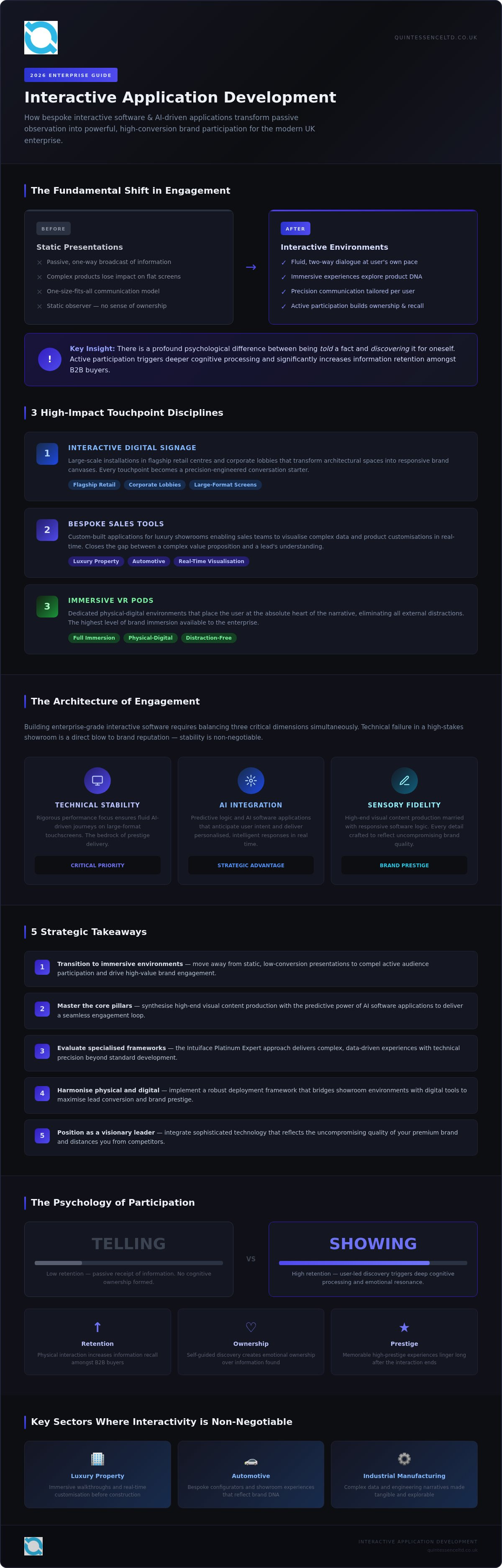
Modern interactivity extends far beyond the confines of a standard tablet or website. It encompasses a total environment designed to envelop the senses and facilitate seamless navigation through information. We categorise these high-impact touchpoints into three distinct disciplines:
INTERACTIVE DIGITAL SIGNAGE: Large-scale installations in flagship retail centres and corporate lobbies that turn architectural spaces into responsive brand canvases.
BESPOKE SALES TOOLS: Custom-built applications for luxury showrooms that allow sales teams to visualise complex data or customisations in real-time.
IMMERSIVE VR PODS: Dedicated physical-digital environments that place the user at the absolute heart of the narrative, removing all external distractions.
These tools don't just present information; they organise it into a prestigious digital presence that reflects the uncompromising quality of the brand. By using interactive application development to create these bespoke tools, businesses move away from the "one-size-fits-all" approach and towards a model of precision communication.
The Psychology of Participation
There is a profound psychological difference between being told a fact and discovering it for oneself. Participation significantly increases information retention amongst B2B buyers, as the act of physical interaction triggers deeper cognitive processing. When a user leads their own discovery, they develop a sense of ownership over the information they find. This shift from "telling" to "showing" is essential for explaining complex products that are difficult to visualise through static imagery alone. Responsive visual content creates emotional resonance by reacting to the user's intent, making the technology feel like an extension of their own curiosity rather than a barrier to it. This creates a memorable, high-prestige experience that lingers long after the interaction ends.
The Architecture of Engagement: Core Components of Bespoke Interactive Software
PRESTIGE. It's the silent requirement for every enterprise-level digital touchpoint. To achieve this, interactive application development must go beyond simple touch-and-reveal mechanics; it requires a robust architecture that balances predictive logic with sensory fidelity. When we build these environments, the goal is to create a seamless loop where the user's intent is met with an immediate, high-fidelity response. This isn't just about code. It's about the precision of a technical specialist married to the visionary flair of a creative studio, ensuring that every interaction feels purposeful rather than performative.
Technical stability remains the bedrock of this architecture. In a high-stakes showroom or flagship retail centre, software failure isn't just a glitch; it's a direct blow to brand reputation. We maintain a rigorous focus on performance, ensuring that even the most complex AI-driven journeys remain fluid on large-format touchscreens. For brands seeking to lead this transition, partnering with a specialist in bespoke interactive app development ensures that every digital touchpoint is both technically sound and creatively inspired.
AI-Driven Interactivity: The New Standard
The integration of AI software applications has fundamentally changed the user journey from a linear path to an adaptive experience. Modern software now learns from user behaviour in real-time, curating content based on what the lead finds most engaging. This means two different users can interact with the same screen and walk away with entirely different, personalised narratives. Predictive sales tools now assist consultants during presentations by surfacing relevant data based on the customer's previous selections, whilst natural language processing allows for voice-activated brand experiences that feel truly futuristic. It's a shift from static menus to intelligent, conversational interfaces that anticipate needs before they're explicitly stated.
Visual Content Production for Interactive Platforms
Standard video production often fails in an interactive context because it's designed for passive observation. Interactive environments require non-linear assets; these are visual components that can be manipulated, rotated, and explored from any angle without a loss in quality. High-end visual content production for these platforms involves creating high-fidelity 3D visualisations that allow for real-time product configuration. This creates a "visual rhythm" that maintains audience attention by providing constant, sensory feedback. We focus on three critical visual pillars:
REAL-TIME RENDERING: Ensuring 3D assets react instantly to user input without lag.
NON-LINEAR NARRATIVES: Designing visual sequences that can be entered or exited at any point.
SENSORY FIDELITY: Using high-resolution textures and lighting to create a tangible sense of quality.
By prioritising these components, interactive application development transforms a simple digital tool into a powerful environment for brand participation. It ensures the technology stays out of the way, allowing the brand's quality and the user's curiosity to take centre stage.
Strategic Platform Selection: Bespoke Development vs Specialised Frameworks
SCALABILITY. It's the pivot point for any enterprise digital strategy. Choosing the right foundation for interactive application development isn't just a technical decision; it's a commercial one that dictates the speed of your ROI. Pure bespoke code offers total control but can often lead to bloated timelines and significant maintenance debt. Conversely, specialised frameworks provide a robust scaffolding that allows for rapid innovation whilst maintaining rigorous standards of performance. The challenge lies in balancing this creative freedom with a software architecture that remains manageable as your brand's digital ecosystem expands across the UK and beyond.
For the modern enterprise, the goal is to achieve a prestigious digital presence without becoming trapped in a cycle of endless development sprints. We view platform selection through the lens of long-term value. Whether you're building a single flagship installation or a network of interactive touchpoints, the underlying technology must support seamless updates and technical stability. This is why the "Intuiface Platinum Expert" status is so critical; it represents a verified level of mastery in a framework designed specifically for high-stakes, data-driven environments where failure isn't an option.
The Case for Intuiface in Enterprise Environments
Intuiface has emerged as the gold standard for complex, data-driven signage and participatory environments. It allows for rapid prototyping and deployment without compromising the visual sophistication that high-end brands demand. Because the framework is built for interactivity, it handles the "Physical-Digital" synergy with ease, allowing for seamless integration with external APIs, IoT devices, and proximity sensors. For organisations with global reach, the platform's centralised management tools are a game-changer. You can organise, update, and monitor your entire interactive estate from a single location, ensuring that your brand narrative remains consistent across every territory.
When to Choose Pure Bespoke AI Development
There are specific scenarios where a ground-up, bespoke approach is the only way to achieve the desired outcome. When your project requires the creation of unique algorithms that serve as a proprietary brand advantage, pure bespoke AI software applications are necessary. This is especially true for immersive VR pods that require deep hardware integration to synchronise physical movement with digital visuals. Additionally, if you're developing custom sales tools with highly specific security requirements or unique data-handling protocols, a bespoke build ensures that every line of code is tailored to your exact specifications. It's about creating a digital asset that is entirely your own, providing a level of exclusivity that off-the-shelf frameworks can't replicate.
Maximising Impact: A Framework for Deploying Interactive Experiences
CONVERSION. It is the only metric that justifies the investment in high-end technology. Whilst the technical architecture and visual fidelity discussed in previous sections provide the foundation, the actual deployment strategy determines whether your project remains a high-tech novelty or becomes a high-performance asset. Successful interactive application development requires a structured framework that guides the user from initial curiosity to a definitive sales action. This process must be measured through clear KPIs that go beyond surface-level clicks, focusing instead on engagement depth, dwell time, and lead quality.
The "Physical-Digital" synergy is particularly vital in showroom and trade show environments. The technology should not exist in a vacuum; it must complement the physical space and the human sales team. By planning for a specific user flow, we ensure that the digital touchpoint enhances the brand experience at every stage. If you're ready to transform your sales environment with a prestigious digital presence, discover how our interactive application development services can elevate your brand activation.
Interactive Technology for Brand Activation
In the high-energy environment of a trade show, you have seconds to capture attention. We utilise a three-stage engagement model to ensure maximum impact:
ATTRACT: A high-fidelity visual loop designed with "visual rhythm" to draw visitors from across the hall.
ENGAGE: Immersive VR pods or touch-enabled displays that invite the user to explore the brand narrative at their own pace.
CONVERT: Integrated lead capture forms or AI-driven data visualisations that provide immediate value in exchange for contact information.
By creating these "shareable" moments, physical installations extend their reach far beyond the venue. When a visitor engages with a bespoke VR environment, they aren't just observing; they're participating in a narrative that is inherently more memorable than any static presentation. We measure success by tracking the depth of these interactions, providing brands with tangible data on which product features or brand values resonate most with their target audience.
The Showroom Revolution: Interactive Sales Tools
The modern showroom is evolving from a storage space into a participatory environment. By replacing static brochures with interactive product configurators, sales teams can demonstrate the full breadth of their offerings without needing every SKU on-site. These tools empower consultants with real-time data, allowing them to handle objections immediately by surfacing technical specifications or case studies at the touch of a screen. This reduces the sales cycle by removing the "I'll email that to you later" friction point. The result is a more professional, authoritative sales process that reflects the uncompromising quality of the brand, ensuring that every lead interaction is maximised for ROI.
Elevating the Experience: The Quintessence Approach to Digital Enablement
VISIONARY. It's the word that defines our approach to digital enablement. Whilst many agencies specialise in either the technical or the creative, Quintessence exists at the precise intersection of both. We act as the strategic bridge between your abstract brand values and tangible, high-tech realities. Our role is to ensure that your message isn't just seen, but felt and understood through a prestigious digital presence. By modernising traditional communication methods, we help UK enterprises replace static, low-impact presentations with a new standard of interactive application development that commands attention and drives results.
Our status as an Intuiface Platinum Expert isn't just a badge; it's a guarantee of technical excellence and global reliability. For brands operating across multiple territories, this expertise ensures that complex, data-driven projects are delivered with surgical precision and managed with ease. We bring the "quiet power" of a boutique agency to every project, offering a level of specialised focus and investment in your long-term digital strategy that larger, more generalised firms simply cannot match.
Bespoke AI and Software Excellence
We believe that software should do more than just respond; it should anticipate. By integrating bespoke AI software applications, we craft environments that learn from user behaviour to provide a more intuitive and personalised journey. This commitment to technical sophistication is always matched by our focus on high-end visual content production. We understand that for a premium brand, the "feel" of the interface is just as important as the code behind it. We focus on three core pillars of excellence:
PREDICTIVE LOGIC: Developing software that surfaces relevant content based on real-time user intent.
SENSORY FIDELITY: Crafting visual assets that reflect the uncompromising quality of your brand.
STRATEGIC ALIGNMENT: Ensuring every digital touchpoint serves a specific, measurable business objective.
Immersive VR Pods and the Future of Sales
Our immersive VR pods represent the absolute pinnacle of experiential marketing. These aren't mere novelties; they're dedicated environments designed to remove all external distractions and place your lead at the heart of your brand's narrative. By combining custom content creation with high-performance hardware, we create sensory experiences that drive tangible ROI in high-stakes sales sectors. Whether you're visualising a multi-million pound property development or a complex industrial solution, our VR environments provide a level of depth and clarity that static media can't hope to achieve. If you're ready to lead your industry through innovation, you can enquire about your bespoke interactive project with Quintessence today. We'll help you master interactive application development to transform your digital strategy into a powerful engine for brand participation and conversion.
Architecting the Next Era of Audience Participation
The transition from passive observation to active participation is no longer a choice for the prestigious brand; it's a prerequisite for influence. The strategic fusion of AI logic and high-fidelity visuals creates environments that don't just inform; they compel action. By prioritising technical stability and choosing scalable frameworks, your brand ensures a digital presence that remains both relevant and robust in the 2026 landscape. This is the new standard for interactive application development, where technology serves as a seamless extension of your brand's quality.
Since 2009, Quintessence has acted as a strategic partner for global brands seeking to modernise their communication through digital enablement. As a UK-based Intuiface Platinum Expert and specialists in immersive VR pods, we provide the "quiet power" and technical precision required to turn abstract concepts into high-impact realities. Partner with a UK-based Intuiface Platinum Expert to transform your brand engagement and secure a digital future that prioritises depth, connection, and measurable results. It's time to let your audience do more than just look; it's time to let them participate.
Frequently Asked Questions
What is the primary benefit of interactive application development for B2B sales?
The primary advantage is the shift from passive observation to active participatory discovery, which significantly increases information retention amongst buyers. By allowing leads to navigate complex product data at their own pace, you remove the friction of traditional presentations. This results in a more authoritative sales presence and a tangible reduction in the time required to handle technical objections.
How does an Intuiface Platinum Expert differ from a standard developer?
An Intuiface Platinum Expert represents the highest level of technical certification within the specialised framework. Unlike standard developers who may use generic web tools, a Platinum Expert has deep mastery over the platform's logic, API integrations, and hardware synchronisation. This ensures your interactive application development project is built on a scalable, enterprise-grade architecture that guarantees reliability in high-stakes environments.
Can interactive software be integrated with existing CRM and AI systems?
Modern interactive platforms are designed to act as a bidirectional data bridge between your brand and your audience. They pull real-time product information from your existing databases whilst pushing granular user behaviour analytics directly back into your CRM. This synergy allows your sales team to follow up with leads based on the specific features or content the user engaged with most during their session.
What industries benefit most from immersive VR pods and interactive displays?
Industries dealing with high-value, complex products that are difficult to visualise through static media see the highest ROI. This includes luxury real estate, aerospace, automotive, and specialised industrial manufacturing sectors. These technologies are essential for bridging the gap between abstract brand values and the tangible realities of a premium product, creating a prestigious digital presence that reflects brand quality.
How long does it typically take to develop a bespoke interactive brand experience?
A bespoke project typically requires between 8 and 16 weeks to move from initial ideation to final deployment. This timeline accounts for the precision of high-end visual content production and the rigorous testing needed for technical stability. Whilst interactive application development for simpler tools may be faster, highly complex AI-integrated systems require a methodical approach to ensure a seamless user experience.
Is interactive digital signage difficult to update once it has been deployed?
Updating your content is remarkably straightforward when managed through a centralised digital enablement platform. Software patches, data refreshes, and new visual assets can be deployed remotely to an entire global estate with a single action. This ensures your brand narrative remains consistent and relevant across every territory without the need for on-site technical support or manual hardware updates.
What is the difference between a standard web app and a bespoke interactive application?
Standard web apps are built for broad browser compatibility, whereas bespoke interactive applications are engineered for specific, high-fidelity physical environments. These applications are optimised for large-format touchscreens and immersive hardware like VR pods, offering a level of sensory depth and performance that web-based tools can't match. They provide a total environment that encourages deep involvement rather than simple, passive browsing.


Comments